 etworthcalculator


What is net worth?
Net worth is the value of everything you own minus everything you owe, on one date. It’s what you’d have left if you sold every asset and paid off every debt that day.
Your home and 401(k) go in at full value, even though you can’t spend that money this week. For the money you could reach in a few days, work out your liquid net worth instead.
The median U.S. family had a net worth of $215,900 in 2025, according to the Federal Reserve’s Survey of Consumer Finances.
How to calculate your net worth
The formula is one line:
Net worth = total assets − total liabilities
- List what you own at today’s value. Pull balances from your bank, brokerage and retirement statements. Price your home from recent sales of similar houses nearby, and your car at private-party value from a guide like Kelley Blue Book.
- List what you owe at the payoff balance. Use the payoff amount on each loan and the full balance on each credit card.
- Subtract. Total assets minus total debts. A positive number means you own more than you owe; a negative one means the opposite.
- Write it down with the date. Do it again on the same day next month and compare.
Take a made-up household. They have $12,000 in savings, $48,000 in a 401(k), a house that would sell for $340,000 and a car worth $18,000. That’s $418,000 in assets.
They owe $265,000 on the mortgage, $9,000 on the car, $22,000 in student loans and $3,500 on a credit card. That’s $299,500 in debts. Their net worth is $418,000 minus $299,500, which comes to $118,500.
Use balances from the same day where you can. Say you note your checking balance, pay $1,000 toward a credit card, then note the card balance. That $1,000 is still counted in checking but already gone from the card, so your total comes out $1,000 too high.
Mistakes that throw the number off
- Typing the monthly payment instead of the balance. A mortgage with a $1,900 payment can still have $265,000 left on it. The balance is the debt.
- Listing home equity instead of the home and the mortgage. Your net worth comes out the same, but you lose sight of how much you owe. In the example above, debts are 72% of assets. List only the $75,000 of equity and they look like 23%.
- Pricing your home at what you paid, or at its tax-assessed value. Use what similar homes nearby sold for recently. Assessed values often lag the market by years.
- Counting life insurance at its death benefit. Only the cash value is yours today. A term policy has none.
- Treating a traditional 401(k) as all spendable. Count the full balance, but remember withdrawals are taxed. At a 22% tax rate, that $48,000 is about $37,400 to spend.
- Adding future Social Security or a pension. Leave them out. They’re income you’ll get later, and the Fed’s survey doesn’t count them either.
Applying for a loan? Lenders often ask for this same math on a signed personal financial statement. Our personal financial statement software, StatementsReady, connects your accounts read-only and fills in the lender’s form, including SBA Form 413.
Got your number? See how it compares with the Federal Reserve’s 2025 figures for median net worth by age.
What counts as an asset
Anything you could sell or cash out, valued at what you’d get for it today:
- Checking, savings and CDs
- Brokerage accounts, stocks, bonds and crypto
- 401(k), IRA and HSA balances
- Your home and any other property, at market value
- Cars, boats and RVs, at private-party value
- Your share of a business you own
Leave out things you’d never sell or that have little resale value, like furniture and clothes.
What counts as a liability
Every balance you’d have to pay off if you settled up today:
- Mortgage, home equity loan or HELOC
- Car loans and leases with a payoff amount
- Federal and private student loans
- Credit card balances
- Personal loans, medical bills and buy now, pay later plans
Monthly bills like rent and utilities are expenses, so they stay out of the math.
Questions
Should I include my home in my net worth?
Yes. Put the home’s full market value with your assets and the mortgage with your debts. Don’t enter your home equity and then subtract the mortgage again, or you’ll count that debt twice.
Does my 401(k) count toward my net worth?
Yes, at its full balance. The money is yours, even though traditional 401(k) withdrawals are taxed and, before age 59½, generally owe a 10% additional tax too. That’s why it’s usually left out of liquid net worth.
What’s the difference between net worth and liquid net worth?
Liquid net worth only counts money you could reach quickly without a big loss: cash, savings and regular brokerage accounts. Home equity, cars and retirement accounts are usually left out, because selling or withdrawing them takes time or comes with taxes and penalties.
Is it bad to have a negative net worth?
It’s common early on, especially with student loans or a new mortgage. Watch the direction: if your net worth goes up a little every few months, you’re on track.
What’s the difference between net worth and income?
Income is what you earn over a stretch of time, like a $95,000 salary. Net worth is what you own minus what you owe on one date. Someone who earns a lot and spends all of it can have a low net worth, and a retiree with a small income can have a high one.
How often should I calculate my net worth?
Once a month or once a quarter is enough. Checking every day mostly shows you stock market noise. Updating on the same day each month gives you a clean trend line.
What’s the difference between a net worth calculator and a net worth tracker?
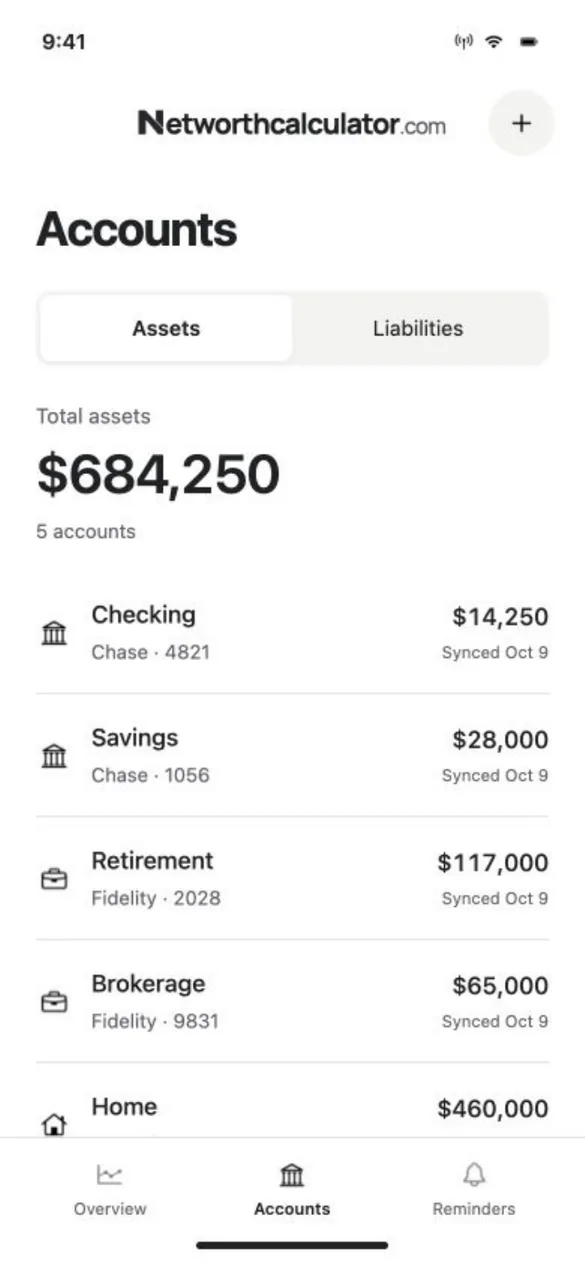
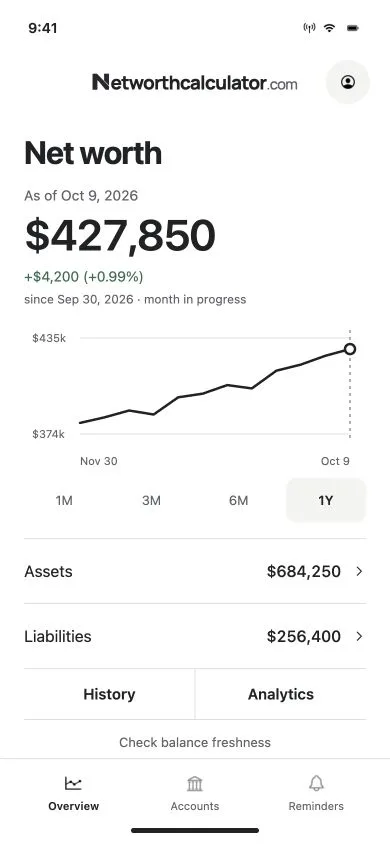
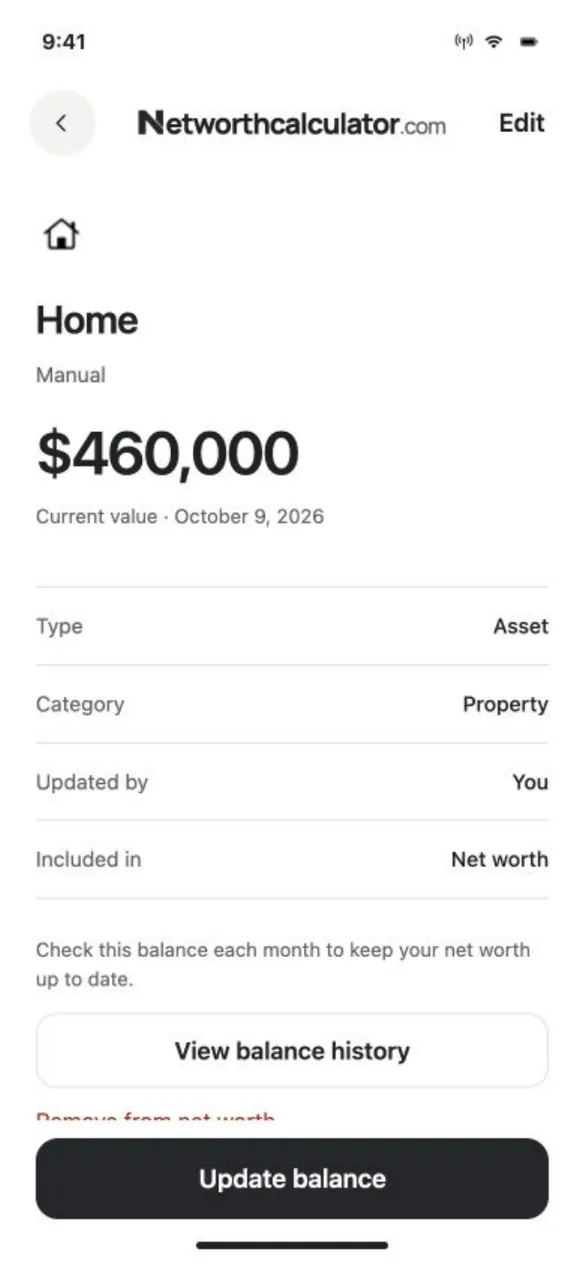
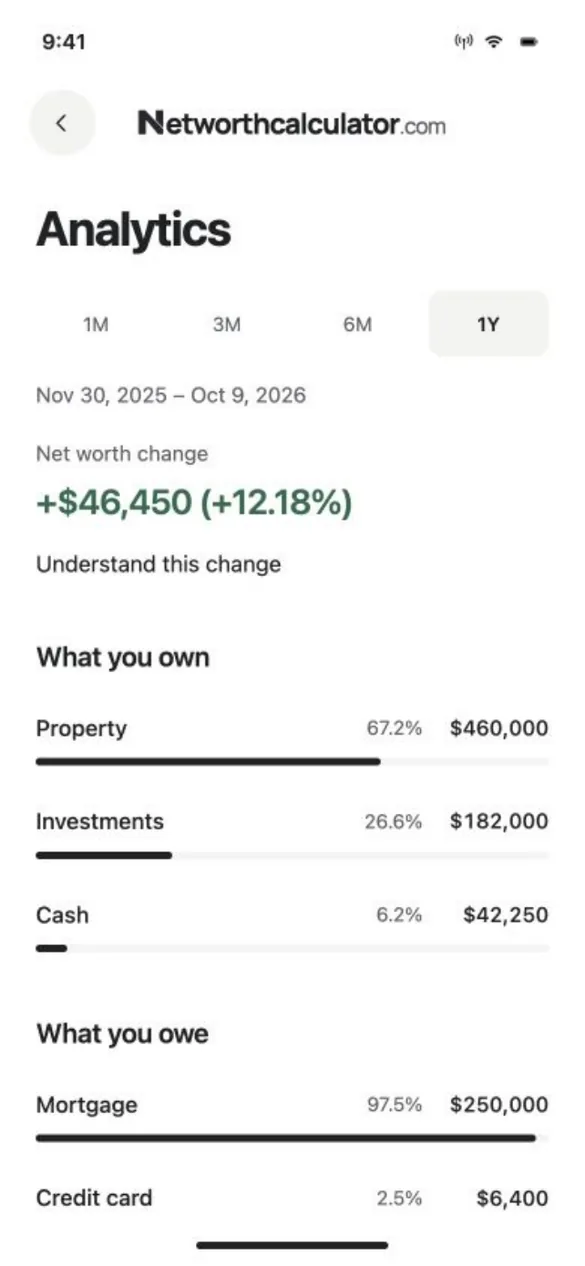
A net worth calculator works out one total from your assets and debts. A net worth tracker saves that total with a date, again and again, so you can compare one month with another. This page is the calculator. The app will do both.
When will the app launch?
We haven’t set a date. Join the launch list and we’ll email you when it’s ready.
Will I have to connect my bank?
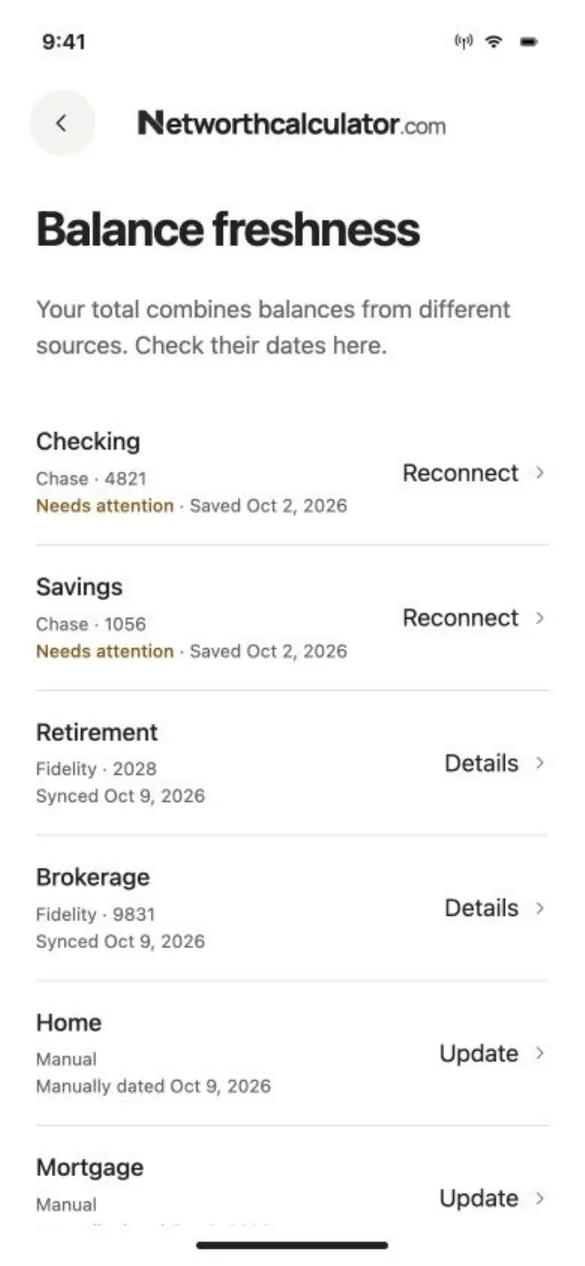
No. Entering balances yourself will be free. Connecting supported bank accounts is optional and comes with the paid plans.
What will the app cost?
Manual tracking will be free. Essentials will be $7 a month or $70 a year and sync up to 5 accounts. Plus will be $19 a month or $190 a year and sync up to 10 accounts across up to 5 bank connections. Both sync once a week, and Plus also lets you tap Sync once a day. Plus will have a 3-day free trial. Joining the launch list doesn’t start a trial or a subscription.
Will I be able to see my old balances?
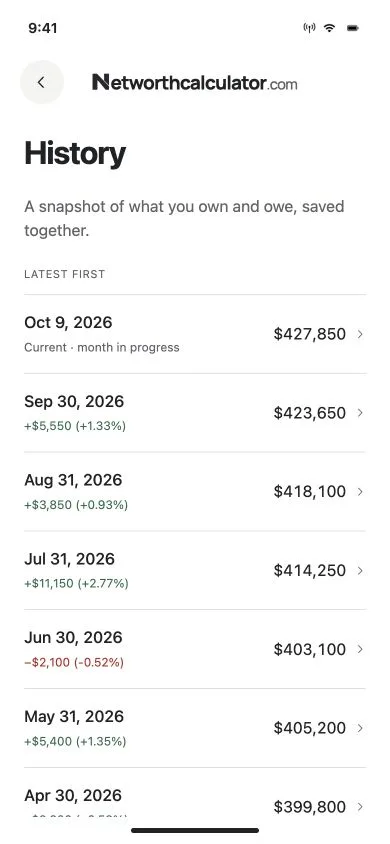
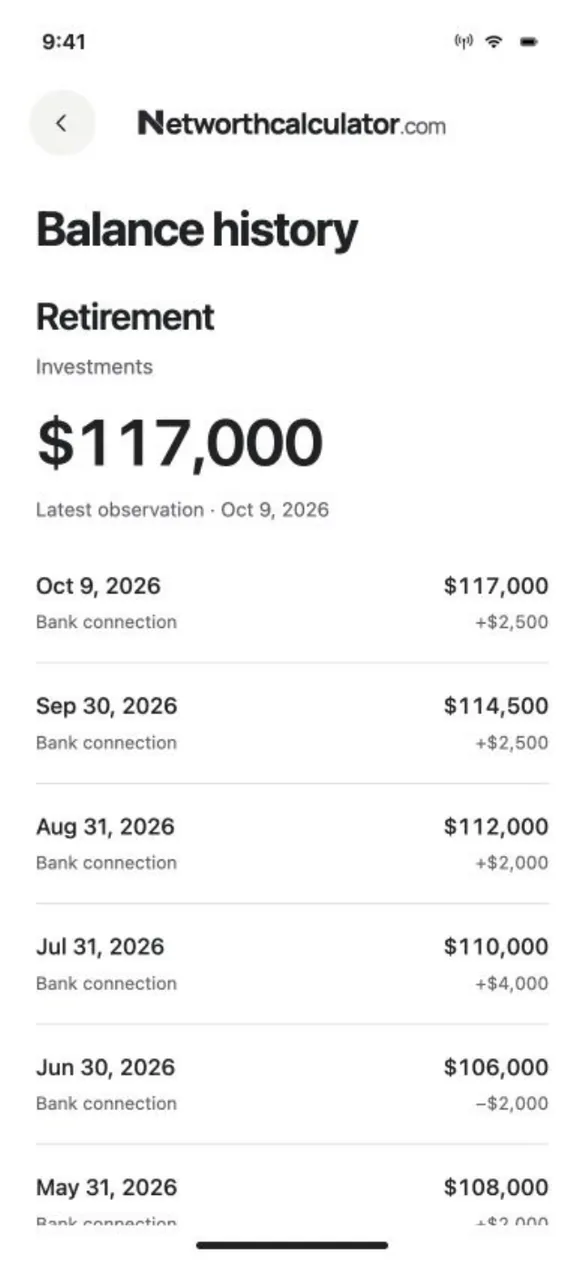
Yes, from the day you start. The app keeps a dated snapshot each time you save, so your history builds as you go. It can’t create records for months you didn’t track.
Last updated